|
|
|
|
Weedy and Leafy Sea Dragon
I first encountered Sea Dragons in the New England Aquarium in Boston back in 2009 and I was fascinated by these creatures. When I started planning my second long diving expedition, viewing them was very high on my list. However, since they mainly live in Tasmania, which is not a diving hotspot, I was sceptical if I could fit the detour into my schedule. Fortunately, I learned that they also can be found in the Sydney harbour and so a plan was made.
Since Dive Center Manly only operated on the weekends, I planned two full weekends in the area, with side trips in between. And having clearly articulated my wishes, the dive guide went out of his way and found Weedy Sea Dragons for us on both weekends
Planning my onwards trip to Perth with a stopover in Adelaide, I learned that there is a different kind of Sea Dragon south of Adelaide, and so I organized a trip with Diving Adelaide.
First we went to Rapid Bay, but we couldn't find any Sea Dragons there. The dive guide then gave us a choice. Either we try again here, or we get back in the car and head to another spot where they recently spotted Sea Dragons. We obviously voted to check out the second spot and so we headed to a dive site called The Bluff in Victor Harbor. And there we were extermely successfull, diving along the kelp and back I counted 10 Leafy Sea Dragons, 6 of which were pregnant males, however, since they all look alike, I might have counted a couple of them twice ;).
So, all in all I was very happy with my dive excursion in southern Australia :).
Here are the original blog posts and web albums:
- Sydney: blog, web album
- Adelaide: blog, web albumLabels: diving, pictures
|
|
Galapagos Penguin
From Honduras my trip continued to Ecuador for the main event, a two week liveaboard cruise in the Galapagos islands. Even though the visibility was not too good at times, we had amazing luck and spotted dozens of Whale Sharks, Hammerhead Sharks, Galapagos Sharks and quite a few playful sea lions.
Hands down the best dive, however, was at Punta Vicente Roca, where we spotted a Mola Mola, Red-lipped Batfish, diving flightless Cormorants, swimming and grazing marine iguanas and diving Galapagos Penguins! And those guys were fast! So I was extermely thrilled that I managed to capture this Snapshot :)
More pictures of this amazing liveaboard can be found here and my original blog post here.Labels: diving, pictures
|
|
Caribbean Reef Shark
Since the beginning of my diving career, I was fascinated by Sharks. Learning to dive in Thailand, I got many close encounters with docile Leopard Sharks, and then of course the jaw-dropping encounter with the Whale Shark.
So in 2012, I finally managed to get some time off to go on a serious diving vacation. The prospect to see Whale Sharks again, brought me to Utila, a small island in Honduras. And indeed, on a snorkling trip, I did encounter a Whale Shark. After Utila I headed onwards to Roatan for some more diving, and especially a shark dive with Caribbean Reef Sharks, where the sharks were lured in by food. I was so excited by the chance to see the sharks up close, that I had trouble finding my camera under water. Fortunately, it was firmly attached and another diver pointed out where it got to.
There were many sharks present and after the feeding, since there was no current, we were allowed to swim towards the sharks for a bit. And there the magical moment happened, a Caribbean Reef Shark lined up with my camera and I managed to get a perfect picture of the shark. This is still my favorite shark picture.
Here is a quote from my original blog post:
Already back in Utila I saw advertisements for Shark Diving in Roatan
and so I booked this dive for Wednesday, it was offered by a company in
Coxen Hole, but a short cab ride took me there. We went down to 20m and
were able to sit/stand in front of 2m high corals, which ensured that no
Sharks would turn up behind us. At first we just watched the Sharks,
there were about 15 female Caribbean Reef Sharks present, but since
there was no current, we were allowed to swim around after a while. And
that was a breathtaking experience, every way I looked, I saw at least
one Shark :). At the end we went back to the Corrals and the Sharks
received the fish they came for, after a short frenzy everything was
eaten and the Sharks disappeared. We then had the opportunity to look
around the bottom for Shark teeth, and even though I was more interested
in looking at the remaining Sharks, my roommate gave me one of the
teeth he found :).
Even though I enjoyed diving in Utila and Roatan, I will most probably not return, because it is very difficult to get there from Switzerland and there are many other places which offer similar or even better diving. Nevertheless, I will always treasure the shark encounters I had there.
More pictures from Honduras can be found in my gallery.Labels: diving, pictures
|
|
Hippocampus Pontohi
From very big to very small. The highlight of my next trip were Pygmy Seahorses, and one in particular, a hugely pregnant male Hippocampus Pontohi.
But let me back up a bit. The year was 2006 and I was in my final year of my undergraduate degree, when I saw a documentary about the Pindito on Swiss television. The Pindito was at the time one of the few liveaboards operating in Raja Ampat, which is located in the North-East corner of Indonesia. I was blown away by the fish live depicted and I decided to give myself this trip as a graduation present.
Because the dive cruise was scheduled over Christmas and New Years Eve, and the plane tickets were at a premium, I decided to head to Indonesia a bit earlier and also visit Bali, Lombok and the Gili islands. One of my most memorable non-diving moments happened on Lombok, when I climbed to the top of Mount Rinjani, but that might be the topic for another best of blog.
On the Pindito, I was introduced to Pygmy Seahorses. Tiny Seahorses that clung to huge fan corals. At first I had a very hard time finding them, even when the dive guide pointed them out, they were so small! And so it felt like a huge achievement, when by the end of the trip, I managed to find them on my own.
At that time the flight connections from Sorong to Singapore weren't that good, so I ended up spending three days near Manado, where I went diving in the Bunaken National Marine Park.
On a dive at Abang Point, our dive guide found this pregnant male Hippocampus Pontohi, only a couple of days before giving birth. Having had lots of experience in the last couple of weeks of taking pictures of Pygmy seahorses I did manage to get a decent shot.
More pictures from that trip can be found here.
Quote from my original blog post:
The last dives
Stranded for two days in
Manado with nothing to do but Scuba-Diving. So that's what I did. My two
last dives of this vacation took place at Bunaken National Park in
North Sulawesi. The dives were fantastic. We saw millions of fishes, as
well as the rare Hippocampus Pontohi, a small seahorse that's just been
discovered two years ago.
However,
there was a lot of trash on the water surface, as well as underwater.
Making me wonder what they use the National Park entrance fee for...
Labels: diving, pictures
|
|
My first whale shark!
Inspired by a 10 photos in 10 days challenge on Facebook and the fact that traveling to go scuba diving is not possible right now, I decided to post pictures from my most memorable dive experiences.
The year was 2004 and I was on my second dive trip, having started diving in autumn of 2003. After visiting the Similan Islands for my first liveaboard trip, I headed onwards to Kho Phi Phi for some more diving. The best known dive sites in the neighbourhood are Hin Daeng and Hin Muang, which are quite a long trip by speed boat, but known for its large pelagic encounters.
On one of the two dives, we suddenly heard a huge commotion from the other side of the rock and our dive guide was quick enough to lead us there and we saw this juvenile Whale Shark swimming by. I tried to follow it for a bit burning through most of my air, but it was worth it, and I got a surprisingly decent shot out of it, considering my lack of experience with underwater photography.
Mor pictures from that trip can be found here, but keep in mind, my photography skills have gotten better since then ;).
And here a quote from my original blog post:
Whale Shark!!!!!!!!!!!
I've travelled to Koh
Phi-Phi yesterday and made a trip to Hin Daeng/Hin Mueng in the south.
There I saw a 6-7m long Whaleshark! Whoa, what an exiting trip. :-)
Labels: diving, pictures
|
|
The Island of Sharks
A visit to Cocos in Costa Rica has long been on my wish-list and this year the time has finally come.
We started our trip with two nights in San José to ensure that everyone gets their diving equipment in case of missing luggage, fortunately, everything arrived on time. So we had a day to kill and we ended up visiting San José Downtown. It was a nice excursion with a couple of interesting old buildings and a fascinating museum showing artifacts of the Native Americans before the Spanish arrived.
The next morning we boarded the Okeanos Aggressor I and got ready for our 36 hour trip to the island. Departing the harbour we spotted many Pelicans.
Farther out lots of Mobula Rays that were jumping out of the water doing somersaults. After a while we were also joined by a pod of dolphins.
Once at our destination we started diving right away. The main reason for my visit was to see Hammerhead Sharks and I was not disappointed. Already during our checkout dive I spotted one swimming past. In the end we saw Hammerhead Sharks on 20 out of 21 dives! (Granted sometimes only a shadow, but still!)
Our time of visit coincided with the rainy season and so we had clouds and rain showers daily, however, from time to time we also saw beautiful landscapes with rainbows!
Sharks weren't the only inhabitants of the reefs, we also spotted lots of Marble Rays, Lobsters, Butterflyfish, Sea Urchins, Pufferfish and from time to time even a Yellowfin Tuna.
In case you are wondering, these are pufferfish, and not Tuna ;)
During the first land visit we could stroll past the ranger accommodation and their garden to the "El Copey" bridge, which was constructed exclusively from confiscated fishing nets.
The two dive spots we visited the most were both fantastic. At Punta Maria, we regularly encountered several Galapagos Sharks and Hammerhead Sharks (which often took a look at us during our safety stop). At Dirty Rock we also regularly spotted Hammerhead Sharks and hundreds of Bigeye Trevalleys.
The second land trip, was highly anticipated by me, because it gave me the opportunity to look for a geocache. After a strenuous climb I could not only enjoy a beautiful view, but also find the Cache, my first one in Costa Rica!
Cocos is not only fascinating under water, but also above, because it boasts a huge number of birds, which often followed our dive boat or were waiting for us when we ascended.
Due to heavy currents we could not dive all the sites, but we did manage to visit Alcyone three times and there we saw large schools of Hammerhead Sharks (at least 60) circling above us. Unfortunately, the visibility was not that great, so my pictures tended to work better in black and white.
From time to time, I also managed to look for the smaller things, because there was plenty. Especially a huge number of Blennies sitting in and on the rocks. This one wanted to say hi ;)
On the way to the last dive we saw a Humpback Whale breaching on the horizon which was a promising start. During the dive we then visited two frogfishes (who probably were relieved when all the paparazzi departed ;) ).
The way back to the mainland was "only" 32 hours, but because the waves were hitting the boat sideways, it ended up being the rougher journey and I was relieved when we finally reached the harbour.
All in all I had a fantastic time and really enjoyed all the great diving :).
This guy distracted me from Shark watching for a bit.
Labels: diving, pictures, traveling, vacation
|
|
Northland and the Far North
Since we wanted to visit both the Northernmost and the Southernmost point on mainland New Zealand, we decided to head Northwards first.
Our first stop on the way northward was Tutukaka, which is the starting point for expeditions to the Poor Knights Islands. The Poor Knights Islands are said to be the Galapagos of New Zealand. The reason for this is, that it lies on the East Australian Current (known from the documentary Finding Nemo), which in summertime regularly brings warm water and fish eggs. This means that around these islands one can encounter tropical fish, which are normally not found at this latitude. On the other hand the rich water flow attracts large pelagics such as huge swarms of Eagle Rays and in very rare circumstances even a Whale Shark.
We were too early for this, but the diving was still very exciting. In cold 16° Celsius water we found lots of Kelp, small Anemones, some corral, Morays, Angelfish, Scorpionfish, Kingfish, Nudibranches, an Octopus and much more. Since Scuba Diving was not the main focus of this vacation, I left my underwater camera at home, so unfortunately, I can only share the pictures that our dive guide took. You can see some pictures in this Facebook post.
During the surface interval we saw a couple of New Zealand Fur Seals on the rocks and could enter the largest Sea Cave in the World (our whole ship fitted inside!).
All in all we had an excellent day.
From Tutukaka we headed Northwards through the region called Northland. We stopped in Mangonui for the night. On the way to dinner we spotted a "Caution Penguin Crossing" sign, but saw no Penguins. However, we did encounter a very friendly Pied Shag (who, according to some people, nearly looks like a pinguin).
From Mangonui we headed to Cape Reinga, the Northernmost light house in New Zealand and the Northernmost point that can easily be accessed. It is located in the region called Far North (the New Zealanders were very innovative when giving names ;) ).
Cape Reinga was extremely busy with tourists, so we headed to Spirits Bay, which only featured a campground, and spent a quiet evening with almost no one around.
Heading back South we stopped at the Kai Iwi Lakes. The largest of which, Lake Taharoa, featured a white sandy beach and a water colour that would put the South Pacific to shame. There is an easy 2 hour walk around it on which we saw the full beauty of the surrounding landscape.
Our last stop in Northland was the very informative Kauri Museum, which features lot of displays depicting rooms and houses from the early settlement and especially everything that had to do with the Kauri tree industry (heavy machinery, a sawmill, lots of samples from different trees).Labels: diving, new zealand, pictures, traveling
|
|
Scuba Diving in the Maldives
It is a bit strange. I've been scuba diving for fourteen years now, with many diving trips all around the world, and yet I have never been in the Maldives. In the past I either went very far away (like Southeast Asia, South Pacific, South America) or stayed close (Egypt, Sudan) and so the Maldives have fallen through the cracks.
When I went hunting for a diving trip for this year, the Maldives weren't at the top of my list, but a good diving buddy spent last years vacation on the Carpe Novo Liveaboard in the Maldives and had such a great time that he wanted to return again this year. So I decided to trust his opinion and join him :).
I didn't quite now what to expect, so I just decided to let myself be surprised. And surprised I was.
The Carpe Novo is the most spacious liveaboard I have seen so far. With space for twenty divers there was a large common area, a separate open air dining room and cabins with a lot of space. One reason for this, was that all the dive equipment including the compressors were on a Donghi, a smaller boat which accompanied us and from which we drove to the dive sites.
Our first dives were in the North Malé Atoll and the second dive at Lankan Faru was already a highlight. At this Manta cleaning station up to 8 Manta Rays were hanging around, swimming in formation and passing right over us. So even with mediocre visibility we got a good view :)
We headed North to the Baa Atoll, where the price for the most beautiful dive site goes to Yellow Wall. A wall covered from top to bottom in yellow Soft Coral.
Over night we headed South to North Ari Atoll where we did two dives at Rasdhoo Ridge. The first dive was already pretty good with a couple of Grey Reef Sharks cruising back and forth in front of us. The second dive managed to top that with dozens of Grey Reef Sharks turning up! A fantastic experience :)
The next day we did a dive at Fish Head in the North Ari Atoll. There our guides spotted a Giant Guitarfish sleeping on the bottom. A personal first, I was very happy to finally see a Guitarfish :)
Traveling farther South to the South Ari Atoll we did a dive at Mahchafushi Wreck. A former shipping boat that was purposefully sunk for diving. Now it offers an interesting spot with lots of coral growth and fish life. Which is good, because next to the wreck there is nothing to see. The last El Niño together with a Crown of Thornes invasion left the complete reef dead. Even though there were still some small fishes around it was a depressing sight. :(
One of the reasons why we traveled to South Ari Atoll, was the chance to see Whale Sharks. The next morning during breakfast the captain went on the lookout and pretty soon they spotted one. We all immediately donned our snorkeling gear and hit the water. The Whale Shark wasn't in a hurry and so we could swim along for a bit. After a dive on the outer reef we stayed on the Dhongi and went looking for more and after a long search we found another. Again we had the chance to swim with it for a good while. Another fantastic experience!
A longer cruise to Vaavu Atoll meant we had to skip the third dive in the afternoon, but we got the opportunity to do a night dive at Alimatha Jetty. This place is famous for its "friendly" Nurse Sharks, Rays and Giant Trevallies. And it was as described. The Sharks and Rays showed no reluctance and cruised around us as if we weren't there. Some of them even touched us when they swam by. What a unique experience! The second best night dive of my career (Flashlight Fish in Vanuatu remain the personal highlight).
Since our trip was coming to a close, we headed back North to South Malé Atoll. At Kandooma Thila we had another chance to see many Grey Reef Sharks and a group of five White Spotted Eagle Rays who just hung there in the current.
After ten days our trip came to a close and we used the last afternoon for a short trip to Malé, the capital of the Maldives, which is the ugliest island I had seen in the Maldives ;)
After this experience I can say that a return to the Maldives is definitely an option to consider. And the Carpe Novo very high on the list for liveaboard of choice.
More pictures can be found in my web album.
If you want to know more about the dive sites we visited and what we saw there, you can check out my online dive log.Labels: diving, pictures, traveling
|
|
Lembeh Strait: Muck Diving at its best!
I first heard about diving in Lembeh Strait ten years ago. Since then I spoke to many enthusiastic divers. From their descriptions I expected to find sandy patches covered in trash and in the middle of the trash all sorts of strange creatures. So it was a bit of a surprise, when I started diving how unpolluted the dive sites actually were. Of course there was a bit of trash here and there but no way the amount I expected. It took a couple of days of diving until I managed to snap a picture which represented my expectations ;)
Knowing what was possible to see at Lembeh, I arrived with a short list of creatures I'd like to encounter. On the very first dive we met two of them: A Flamboyant Cuttlefish and a Hairy Frogfish!
A couple of days later we encountered another Hairy Frogfish that wasn't just sitting around, but walking across the sand shaking its lure in hopes of attracting prey.
Some creatures were so abundant that we encountered them on most dives. I especially enjoyed seeing the Banggai Cardinalfish over and over again. They have such a peculiar shape and had formed a habit of living in Anemones, where strangely enough the Anemonefish tolerate them. On the other hand, when I got too close to take a picture an Anemonefish bit me in the finger!
One fish that I always enjoyed looking at in Fish Identification Guides was the Juvenile Many-Spotted Sweetlips, with its big white dots and it's bright coloring it looked so different from the adults. So I was extremely happy to encounter them in all sizes, from tiny (less than 1 centimeter) up to almost adult (15 centimeters).
The smaller ones were very difficult to photograph because they always moved around in a shaking pattern, probably trying to mimic a poisonous flatworm. After a dozen tries I managed to get one picture with the juvenile in focus :)
Night dives were a special highlight, there was even more going on than during the day. And on one night dive I encountered one of the strangest creatures I met so far, a pair of Dragon Sea Moths
The dive guides had excellent eyes and spotted the interesting creatures often from afar. Some of the creatures I had seen previously during this trip were present in Lembeh as well, but in much bigger variations, such as this Emperor Shrimp:
Or these two Harlequin Shrimps
Even though most crabs only came out during the night time, I spotted this strange looking Sea Urchin Carry Crab during an afternoon dive.
During my time at Blue Bay Divers two Bluering Octopi were seen, unfortunately for me I was always in the wrong spot. So I told my dive guide that I'd like to see a Bluering Octopus here. Two times we headed to dive sites where Bluerings normally were seen. The second time we got lucky :)
To round off a perfect Octopus day, we spotted a Poison Ocellate Octopus
and a Starry Night Octopus, which walked along the ocean floor in a very laid-back manner ;)
Another instance where we noticed that some critters just were bigger at Lembeh than elsewhere was when we did a dive at Police Pier, where we spotted very big Mandarinfish darting around the reef.
Or on another day when we spotted this Tryon's Risbecia
One day we were very lucky to spot a Wonderpus Octopus at the end of the dive. Since it was relaxed we ended up spending ten minutes with him :)
This meant that only one Octopus from my list was still missing. The Mimic Octopus. And so we went to a specific dive site to take a look. One of the groups spotted it early in the dive and tried to alert us. While I heard nothing I noticed our dive guide heading very directly back to where we started the dive and so we also got a good luck. Unfortunately, the Mimic Octopus was in a hurry and so we managed to snap only a few pictures.
Another creature we had many encounters with was the Mantis Shrimp. Two of those encounters stood out. One day our dive guide spotted a Peacock Mantis which had a large number of eggs under its belly
and during the last dive we encountered the beautiful Golden Mantis :)
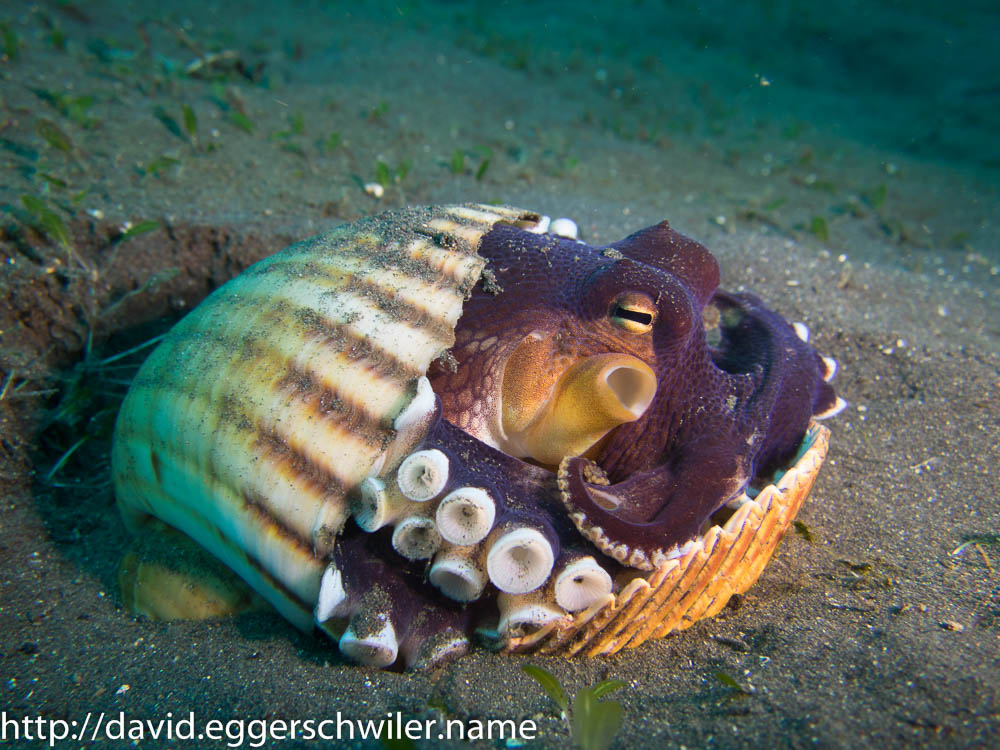
To round up the Octopus Sextet we again had many encounters with Coconut Octopi. From one of those my favorite picture emerged
All in all my one-week stay at Lembeh was a phenomenal success and I can highly recommend it to divers who enjoy muck dives (even if it means staring at sand for ten minutes, without seeing anything) and want to see special creatures. If I get back to Indonesia, then I'll definitely try to dive in Lembeh Strait again :).
Labels: diving, pictures, traveling, vacation
|
|
|