|
|
|
|
The Island of Sharks
A visit to Cocos in Costa Rica has long been on my wish-list and this year the time has finally come.
We started our trip with two nights in San José to ensure that everyone gets their diving equipment in case of missing luggage, fortunately, everything arrived on time. So we had a day to kill and we ended up visiting San José Downtown. It was a nice excursion with a couple of interesting old buildings and a fascinating museum showing artifacts of the Native Americans before the Spanish arrived.
The next morning we boarded the Okeanos Aggressor I and got ready for our 36 hour trip to the island. Departing the harbour we spotted many Pelicans.
Farther out lots of Mobula Rays that were jumping out of the water doing somersaults. After a while we were also joined by a pod of dolphins.
Once at our destination we started diving right away. The main reason for my visit was to see Hammerhead Sharks and I was not disappointed. Already during our checkout dive I spotted one swimming past. In the end we saw Hammerhead Sharks on 20 out of 21 dives! (Granted sometimes only a shadow, but still!)
Our time of visit coincided with the rainy season and so we had clouds and rain showers daily, however, from time to time we also saw beautiful landscapes with rainbows!
Sharks weren't the only inhabitants of the reefs, we also spotted lots of Marble Rays, Lobsters, Butterflyfish, Sea Urchins, Pufferfish and from time to time even a Yellowfin Tuna.
In case you are wondering, these are pufferfish, and not Tuna ;)
During the first land visit we could stroll past the ranger accommodation and their garden to the "El Copey" bridge, which was constructed exclusively from confiscated fishing nets.
The two dive spots we visited the most were both fantastic. At Punta Maria, we regularly encountered several Galapagos Sharks and Hammerhead Sharks (which often took a look at us during our safety stop). At Dirty Rock we also regularly spotted Hammerhead Sharks and hundreds of Bigeye Trevalleys.
The second land trip, was highly anticipated by me, because it gave me the opportunity to look for a geocache. After a strenuous climb I could not only enjoy a beautiful view, but also find the Cache, my first one in Costa Rica!
Cocos is not only fascinating under water, but also above, because it boasts a huge number of birds, which often followed our dive boat or were waiting for us when we ascended.
Due to heavy currents we could not dive all the sites, but we did manage to visit Alcyone three times and there we saw large schools of Hammerhead Sharks (at least 60) circling above us. Unfortunately, the visibility was not that great, so my pictures tended to work better in black and white.
From time to time, I also managed to look for the smaller things, because there was plenty. Especially a huge number of Blennies sitting in and on the rocks. This one wanted to say hi ;)
On the way to the last dive we saw a Humpback Whale breaching on the horizon which was a promising start. During the dive we then visited two frogfishes (who probably were relieved when all the paparazzi departed ;) ).
The way back to the mainland was "only" 32 hours, but because the waves were hitting the boat sideways, it ended up being the rougher journey and I was relieved when we finally reached the harbour.
All in all I had a fantastic time and really enjoyed all the great diving :).
This guy distracted me from Shark watching for a bit.
Labels: diving, pictures, traveling, vacation
|
|
Dartmoor Way
After our great experience on the Coleridge Way last year, we decided to come back to South-West England to hike in and around the Dartmoor National Park.
We started in Buckfastleigh which was easy to reach from London, first a modern train to Totnes and from there the South Devon Steam Railway. A very nice option to slow down and enjoy the area.
Close to our pub was the impressive Buckfast Abbey, a still active monastery which goes back to 1018.
 |
| Buckfast Abbey |
The first day brought some technical trouble, with the GPS not displaying our route, fortunately our phones acted as a perfect back up. Compared to the Coleridge Way, the Dartmoor Way was very poorly signposted, so we were very glad for the digital maps and way points. After a short stretch along the main road we headed through back roads, small tracks and woodland. Enjoying beautiful views on the way.
 |
| Nice view |
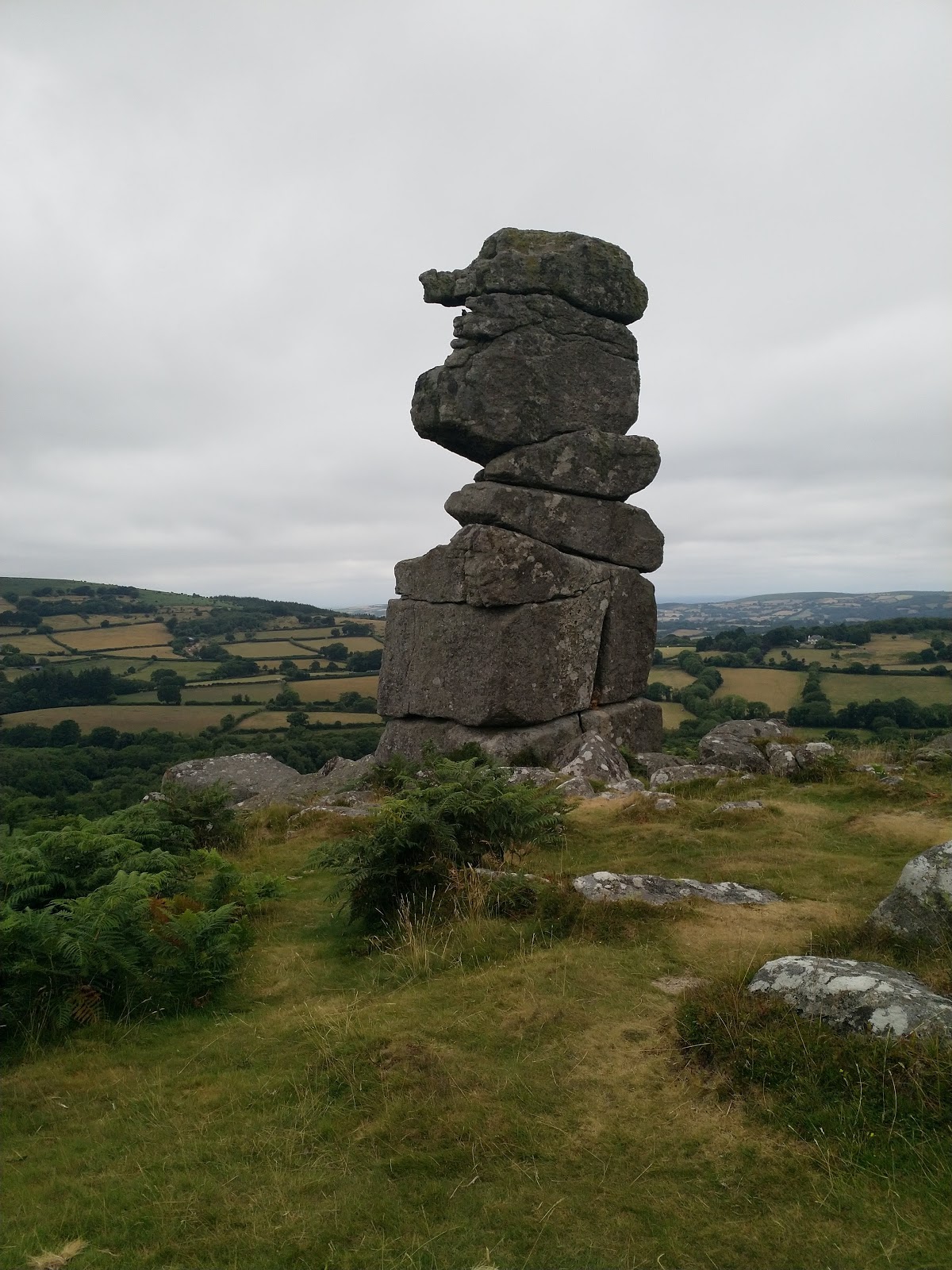
We added an extra night at Bovey Tracey, which gave us the option to explore the High Tors. After being dropped off at Manaton we visited Hounds Tor, Bowerman's Nose and Haytor.
 |
| Bowerman's Nose |
This was a wonderful hike with beautiful views, many interesting stone formations and our first Dartmoor Ponies! Around Haytor we found an extensive network called the Granite Tramway. This was built in 1820 to transport the local granite from the quarries to the shore. The trams were pulled uphill by a team of horses and rolled downhill by gravity.
 |
| Track Switch of the Granite Railway |
Day three saw us on the road again with our full backpacks. Hiking along beautiful tracks we headed to North Bovey, where we encountered many thatched houses and stayed at the wonderfully renovated Ring of Bells Inn.
 |
| Thatched House in North Bovey |
Day four brought us deeper into the Moor, with beautiful views and quite a bit of up and down. Since we had time we made a detour to visit Castle Drogo, which looks like a real castle but was only built in 1911 and is now part of the National Trust and can be visited. It is very interesting to learn about its history and see what comforts were built in at the time.
 |
| Standing Stone at the top of the hill |
From Chagford we headed to Okehampton. This was the second most impressive stretch (after Haytor) and the most strenuous so far. We encountered many animals today: Dartmoor Ponies, Cows and dozens of Sheep (such as the little lamb that didn't quite know what to do with us). And yet after we reached Belstone we decided to use the nice weather and head further into the Moor, where we found a wide open space with stunning views all around. After a moderate descent we followed a picturesque track along the East Okement River into Okehampton. Unfortunately, after seven hours, my GPS ran out of battery, so we don't know how many kilometers we did that day, but it was definitely more than 20.
 |
| Little Lamb |
Crossing several meadows and open spaces where we spotted many sheep, we headed downhill again, where we encountered the Highwayman Inn, a very peculiar place with rooms chuck full of artifacts and lots of decoration. The owners are very friendly and happy to tell more about the place. Definitely worth a stop, even if just for a drink. Unfortunately, this is where the weather turned bad, after five days of sunshine and pleasant temperatures it started to rain. Not for long, but it was a precursor of what was to come. On the last stretch of the day we came across a Geocaching Power Trail and used this to log a couple of more Caches than on the other days :).
 |
| The Highwayman Inn |
Last year, we were pretty exhausted after six days of walking, so this time we planned a rest day in Lydford, which gave us the opportunity to wash some of our clothes. Since the weather was good in the morning we headed into the moor, where I couldn't resist finding a T5 swimming/diving Geocache. And the water was so cold! But definitely worth it. Afterward we climbed up to Widgery Cross. On the way down it started to rain again, so we headed back to the hotel to warm up. Later as it looked a bit better we headed to Lydford Gorge, a stunning valley with a waterfall.
 |
| Widgery Cross |
The next day, the weather looked so so. Nevertheless, we gave it a try and headed off. However, the steady rain with the heavy wind (so that the rain was coming at us horizontally!), really dampened us and our mood. We saw nothing of the promised views and decided to add a lunch stop in a pub. After being dry again and looking outside, we decided that was it for the day and took a cab into Tavistock.
 |
| Rainy Dartmoor |
The next morning the weather didn't look too good yet, so we explored Tavistock on foot before taking the bus to Princetown. From there we took a short walk to Kings Tor where we had a fantastic experience with upcoming fog, and we finally understood why everyone warns from entering the Moor during bad weather. Fortunately, Kings Tor was in the middle of a loop road and with our GPS devices we always knew where we were. At Kings Tor we encountered another large group of Dartmoor Ponies including a foal!
 |
| Dartmoor Ponies with Foal |
The last day fortunately brought better weather and we had a fantastic walk, with quite a bit of up and downs but again with many animals and wonderful landscape. After 9.5 hours of walking my GPS ran out of battery again, at this time we had already covered 27.5 kilometers and it took us another half hour to reach our final destination, where we devoured a large dinner.
 |
| Dart River |
Before heading back to London we had some time to explore Totnes which has a very nice town center with many old buildings.
 |
| Totnes Castle | | |
| |
We've grown very fond of the Dartmoor region during our time there, and we may return for another hiking vacation.
According to my GPS we covered 182 kilometers in 11 days. The gap in the top is due to GPS failure, the gap at the bottom is due to bus and cab during bad weather.
We arranged this trip with the help of Encounter Walking Holidays,
who were very friendly and did a great job in supplying us with all
needed information as well
as organizing all accommodation on the way.Labels: geocaching, hiking, pictures, traveling, vacation
|
|
Lembeh Strait: Muck Diving at its best!
I first heard about diving in Lembeh Strait ten years ago. Since then I spoke to many enthusiastic divers. From their descriptions I expected to find sandy patches covered in trash and in the middle of the trash all sorts of strange creatures. So it was a bit of a surprise, when I started diving how unpolluted the dive sites actually were. Of course there was a bit of trash here and there but no way the amount I expected. It took a couple of days of diving until I managed to snap a picture which represented my expectations ;)
Knowing what was possible to see at Lembeh, I arrived with a short list of creatures I'd like to encounter. On the very first dive we met two of them: A Flamboyant Cuttlefish and a Hairy Frogfish!
A couple of days later we encountered another Hairy Frogfish that wasn't just sitting around, but walking across the sand shaking its lure in hopes of attracting prey.
Some creatures were so abundant that we encountered them on most dives. I especially enjoyed seeing the Banggai Cardinalfish over and over again. They have such a peculiar shape and had formed a habit of living in Anemones, where strangely enough the Anemonefish tolerate them. On the other hand, when I got too close to take a picture an Anemonefish bit me in the finger!
One fish that I always enjoyed looking at in Fish Identification Guides was the Juvenile Many-Spotted Sweetlips, with its big white dots and it's bright coloring it looked so different from the adults. So I was extremely happy to encounter them in all sizes, from tiny (less than 1 centimeter) up to almost adult (15 centimeters).
The smaller ones were very difficult to photograph because they always moved around in a shaking pattern, probably trying to mimic a poisonous flatworm. After a dozen tries I managed to get one picture with the juvenile in focus :)
Night dives were a special highlight, there was even more going on than during the day. And on one night dive I encountered one of the strangest creatures I met so far, a pair of Dragon Sea Moths
The dive guides had excellent eyes and spotted the interesting creatures often from afar. Some of the creatures I had seen previously during this trip were present in Lembeh as well, but in much bigger variations, such as this Emperor Shrimp:
Or these two Harlequin Shrimps
Even though most crabs only came out during the night time, I spotted this strange looking Sea Urchin Carry Crab during an afternoon dive.
During my time at Blue Bay Divers two Bluering Octopi were seen, unfortunately for me I was always in the wrong spot. So I told my dive guide that I'd like to see a Bluering Octopus here. Two times we headed to dive sites where Bluerings normally were seen. The second time we got lucky :)
To round off a perfect Octopus day, we spotted a Poison Ocellate Octopus
and a Starry Night Octopus, which walked along the ocean floor in a very laid-back manner ;)
Another instance where we noticed that some critters just were bigger at Lembeh than elsewhere was when we did a dive at Police Pier, where we spotted very big Mandarinfish darting around the reef.
Or on another day when we spotted this Tryon's Risbecia
One day we were very lucky to spot a Wonderpus Octopus at the end of the dive. Since it was relaxed we ended up spending ten minutes with him :)
This meant that only one Octopus from my list was still missing. The Mimic Octopus. And so we went to a specific dive site to take a look. One of the groups spotted it early in the dive and tried to alert us. While I heard nothing I noticed our dive guide heading very directly back to where we started the dive and so we also got a good luck. Unfortunately, the Mimic Octopus was in a hurry and so we managed to snap only a few pictures.
Another creature we had many encounters with was the Mantis Shrimp. Two of those encounters stood out. One day our dive guide spotted a Peacock Mantis which had a large number of eggs under its belly
and during the last dive we encountered the beautiful Golden Mantis :)
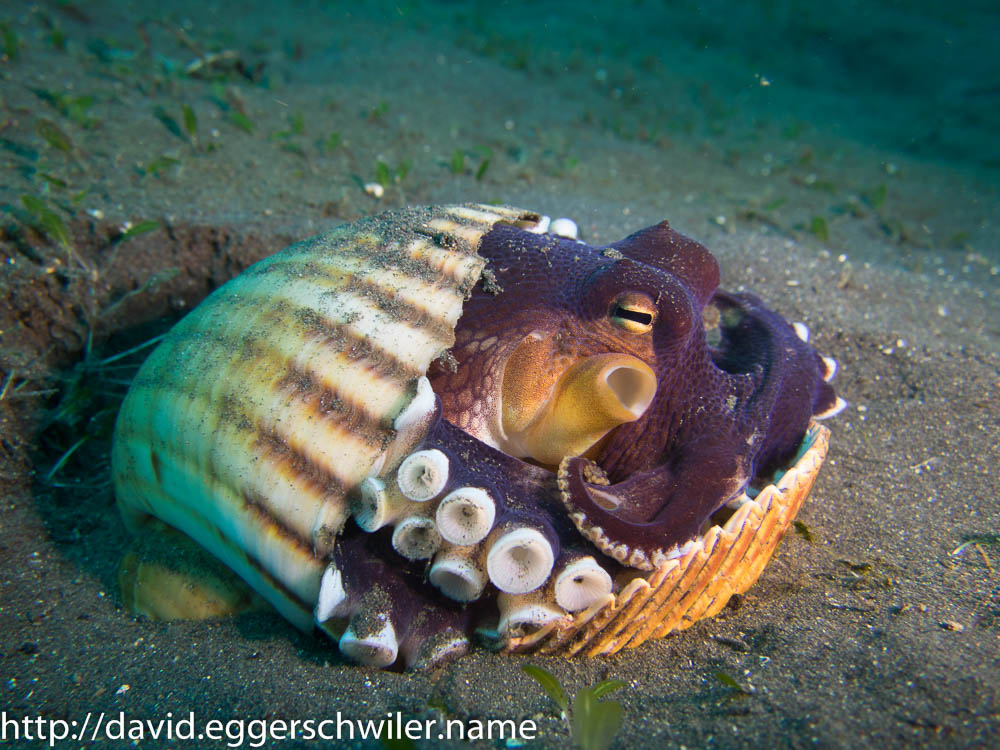
To round up the Octopus Sextet we again had many encounters with Coconut Octopi. From one of those my favorite picture emerged
All in all my one-week stay at Lembeh was a phenomenal success and I can highly recommend it to divers who enjoy muck dives (even if it means staring at sand for ten minutes, without seeing anything) and want to see special creatures. If I get back to Indonesia, then I'll definitely try to dive in Lembeh Strait again :).
Labels: diving, pictures, traveling, vacation
|
|
Diving with Coconut Octopus and other cool creatures
Leaving Raja Ampat I took the plane to Manado in North Sulawesi and from there a car and boat to the beautiful small island Sahaung, just South of Bangka Island. Sahaung is home to Blue Bay Divers and offers a real small island feeling with nice beach side bungalows and a relaxed atmosphere.
The first dive already showed the potential of the area. We saw a small Harlequin Shrimp, several Giant Frogfish, a Pygmy Seahorse and much more.
The dive sites were very varied. Sandy areas for pure muck diving, walls with current for drift diving and nice corral fields. On one memorable wall dive we spotted two Painted Frogfish on a wall, one of them chased after my camera!
Whenever possible I joined the night dive, because there was even more going on than during the day. On one dive I encountered two Bobtail Squids and one showed off it's whole color palette. (You can also see the krill in the picture, which was plentiful and sometimes a bit annoying ;) ).
On another night we encountered multiple smaller Coconut Octopi. One of them found shelter in a small snail shell.
Another used two halves of a clam, which he carried with him when we got to close, to finally retreat in their middle.
On the last day we visited Batu Sahaung, a stony reef just around the corner, which is covered in Soft Coral in all colors! I have never seen so many differently colored Soft Coral in such a small space before. It was simply beautiful!
With so much diving one day merged into the next and then it was suddenly time to continue to the next spot. I had a great experience and am looking forward to return one day!
Labels: diving, pictures, traveling, vacation
|
|
|